
Why Use QR Labels: Complete Expert Guide
Over 94 million american adults scanned a QR code last year, making these smart labels an everyday part of modern life. Whether you are managing family keepsakes or running a business, QR labels turn ordinary objects into digital touchpoints that provide instant access to information. As their use continues to soar, knowing what sets QR labels apart will help you embrace simple and reliable ways to organize, share, and protect the things that matter most.
Table of Contents
- What Are QR Labels Exactly
- Types Of QR Labels Explained
- How QR Labels Actually Work
- Key Advantages And Characteristics
- Use Cases For Personal And Business Needs
- Durability And Design Considerations
Key Takeaways
| Point | Details |
|---|---|
| Innovative Functionality | QR labels transform physical items into interactive information portals, allowing users to access a wealth of digital content with a simple scan. |
| Diverse Applications | They can be utilized for personal organization, business inventory management, and preserving memories, demonstrating their broad versatility. |
| Technical Advantages | QR labels offer high data storage capacity, omnidirectional readability, and built-in error correction, ensuring reliable performance even if damaged. |
| Design Considerations | Effective QR labels must balance visual appeal with functionality, optimizing contrast and durability to ensure consistent readability in various conditions. |
What Are QR Labels Exactly
QR labels are smart, digitally-enabled stickers that transform physical objects into interactive information portals. According to Wikipedia, QR codes are two-dimensional matrix barcodes originally invented in 1994 by Masahiro Hara of Denso Wave, consisting of black squares arranged on a white background that can store various types of data like URLs, text, and other information.
These innovative labels work by encoding information both horizontally and vertically, which allows for significantly greater data storage compared to traditional one-dimensional barcodes. IJARSCT Research highlights that QR codes are renowned for their fast readability and remarkable versatility in encoding different types of information. When someone scans a QR label with a smartphone or camera-enabled device, they instantly access the embedded digital content.
QR labels serve multiple practical purposes across personal and professional contexts. They can be used to:
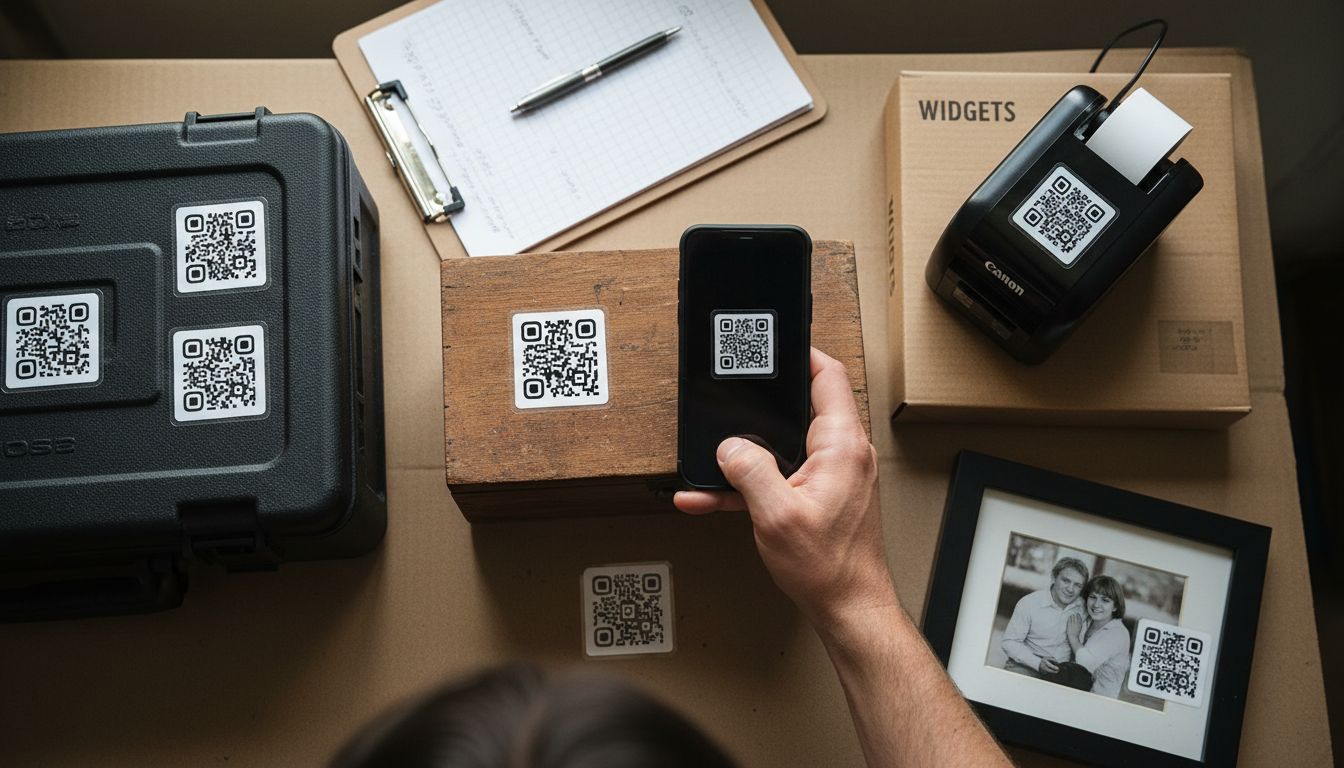
- Preserve family memories by attaching digital stories to physical objects
- Create visual inventories for home and office storage
- Track and manage personal and business items
- Share instant access to instructions, warranties, or additional product information
- Record and preserve sentimental narratives about cherished possessions
What makes these labels truly powerful is their ability to bridge physical and digital worlds seamlessly. By transforming ordinary stickers into gateways of rich, multimedia information, QR labels offer an intuitive and engaging way to document, share, and interact with the objects that matter most to us.
Types Of QR Labels Explained
QR labels come in several distinct varieties, each designed to meet specific needs and applications. Wikipedia reveals that QR codes have evolved to include specialized types like Micro QR codes, which are compact versions ideal for spaces with limited real estate, and iQR codes, offering enhanced data capacity and unique printing capabilities.
One fascinating variant is the Rectangular Micro QR Code (rMQR Code), which addresses design constraints of traditional square formats. According to Wikipedia, this innovative design allows for better utilization of rectangular areas, making it particularly useful in scenarios where standard square QR codes might be impractical. This flexibility enables businesses and individuals to integrate QR labels into tight or uniquely shaped spaces.
The main types of QR labels can be categorized as follows:
- Standard QR Codes: The most common type, supporting multiple data types
- Micro QR Codes: Smaller versions for compact spaces
- iQR Codes: High-capacity codes with flexible shape options
- Rectangular Micro QR Codes: Optimized for rectangular printing areas
- Model 2 QR Codes: Enhanced error correction and data storage capabilities
Learn more in our tutorial on step by step QR code labeling, which provides practical insights into selecting and implementing the right QR label type for your specific needs. Whether you’re organizing personal collections, managing business inventory, or creating interactive memory markers, understanding these different QR label types empowers you to choose the most effective solution for your unique requirements.
How QR Labels Actually Work
QR labels operate through a sophisticated encoding and decoding process that transforms digital information into a visual pattern of black and white squares. Wikipedia explains that these codes function by encoding data into a complex matrix of squares, which can be quickly scanned and interpreted by imaging devices using advanced error correction algorithms.
The technical magic happens through a precise binary conversion process. According to IJARSCT Research, QR codes convert digital data into a binary format, which is then strategically arranged into a two-dimensional matrix. This matrix includes critical error correction codes that ensure data integrity, allowing accurate decoding even if the label is partially damaged or distorted.
The scanning and information retrieval process involves several key steps:
- Data Conversion: Digital information gets transformed into binary code
- Matrix Encoding: Binary data is arranged into a two-dimensional square pattern
- Error Correction Integration: Redundancy codes are added to protect data
- Visual Representation: Black and white squares create the final QR code
- Scanning Recognition: Devices read and decode the visual pattern
Explore our comprehensive guide to information access via QR codes to dive deeper into the fascinating world of digital labeling technology. By understanding how QR labels work, you can unlock powerful ways to store, share, and retrieve information with just a simple scan.
Key Advantages And Characteristics
Wikipedia highlights the remarkable versatility of QR labels, revealing their exceptional ability to store diverse types of information including URLs, text, and contact details. These innovative labels stand out for their high data storage capacity, allowing users to pack significant amounts of digital information into a compact visual format that can be easily scanned and accessed.
According to IJARSCT Research, QR codes possess unique omnidirectional readability, meaning they can be scanned from any angle or direction. This characteristic sets them apart from traditional one-dimensional barcodes, providing unprecedented flexibility in information retrieval. The two-dimensional structure enables greater data capacity and more robust information encoding, making QR labels an incredibly powerful tool for personal and professional information management.
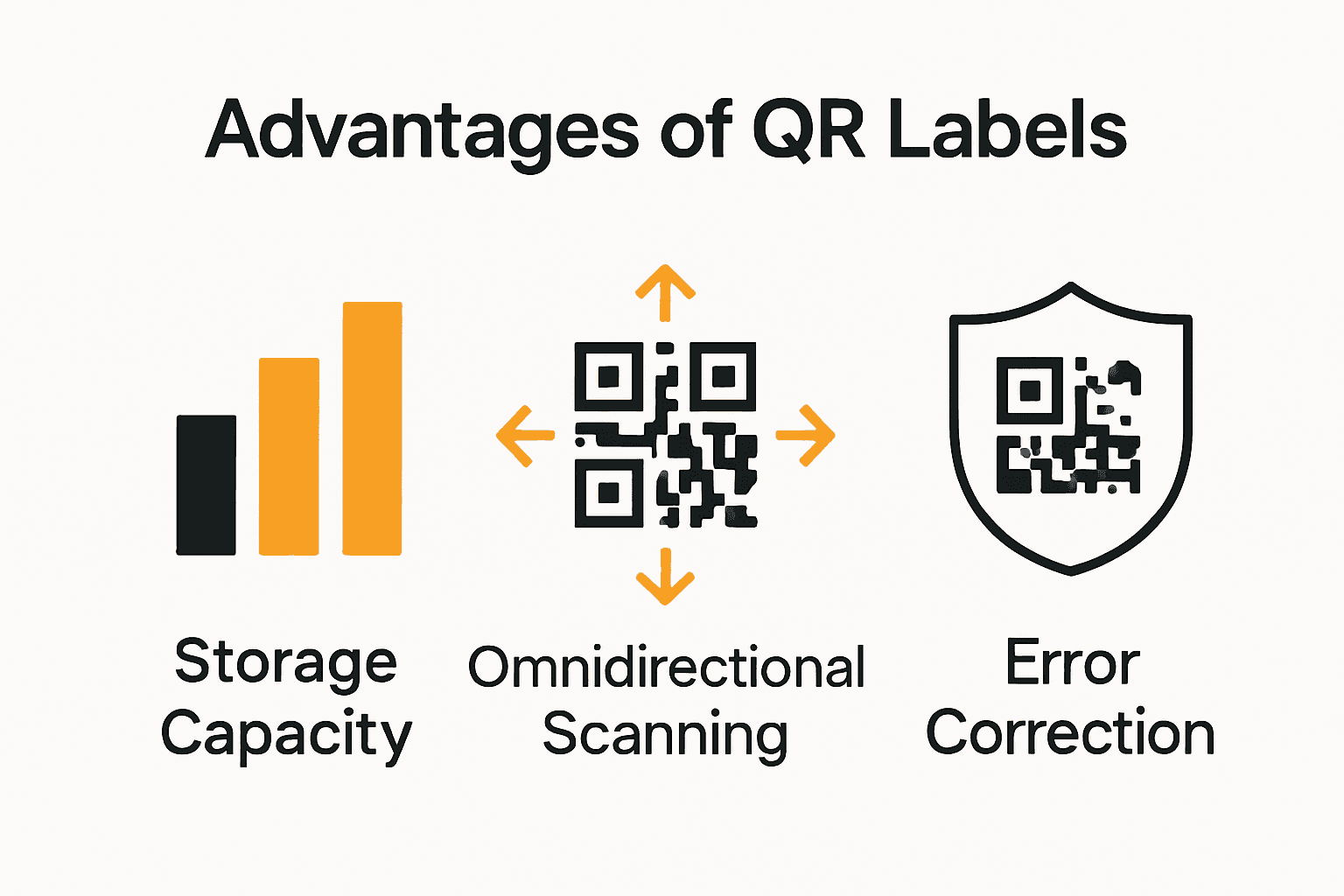
The key advantages of QR labels include:
- Versatile Data Storage: Encode multiple data types
- Error Correction: Maintain data integrity even if partially damaged
- Quick Scanning: Instant information retrieval
- Compact Design: Store extensive information in small visual space
- Omnidirectional Reading: Scan from any angle
Explore our guide on smart ways to use QR code labeling for businesses to discover the transformative potential of these powerful digital tools. By understanding their unique characteristics, you can leverage QR labels to streamline information sharing, enhance organizational systems, and create more interactive experiences across personal and professional domains.
Use Cases For Personal And Business Needs
Wikipedia reveals the incredible versatility of QR labels across personal and professional domains. These digital tags have transformed how we track, share, and manage information, offering seamless solutions for product identification, document management, and instant digital connectivity. From small home projects to large corporate environments, QR labels provide a universal tool for organizing and accessing critical information quickly and efficiently.
According to IJARSCT Research, QR codes are employed across diverse contexts, enabling users to share contact information, process payments, and access digital content with unprecedented ease. The adaptability of these labels means they can serve multiple functions, bridging physical and digital communication channels in ways traditional methods cannot.
Practical use cases span multiple domains:
-
Personal Organization
- Tracking family heirlooms and keepsakes
- Creating digital inventories of personal collections
- Preserving stories and memories attached to special items
-
Business Applications
- Product tracking and inventory management
- Quick access to equipment manuals and maintenance records
- Marketing campaign information distribution
- Asset management and documentation
Explore our comprehensive guide to QR code information access to unlock the full potential of these powerful digital labels. By understanding their wide-ranging applications, you can transform how you store, share, and interact with information across personal and professional landscapes.
Durability And Design Considerations
Wikipedia reveals a remarkable feature of QR labels: their extraordinary resilience through advanced error correction technology. By incorporating Reed-Solomon algorithms, these digital labels can maintain functionality even when up to 30% of the code becomes damaged or obscured, ensuring reliable performance in challenging environments like workshops, storage spaces, and outdoor settings.
Design considerations go far beyond mere durability. According to advanced research, creating effective QR labels requires a delicate balance between visual aesthetics and scanning reliability. The goal is to craft labels that are not just functional, but also visually appealing while maintaining high readability across different lighting conditions and surfaces. Contrast, luminance, and placement become critical factors in ensuring consistent performance.
Key durability and design elements include:
- Damage Resistance: Maintain 70-80% functionality even when partially obscured
- Environmental Adaptability: Perform in temperature variations and moisture
- Scanning Angle Flexibility: Readable from multiple perspectives
- Material Compatibility: Adhere to various surface types
- Color and Contrast Optimization: Ensure clear visual distinction
Explore our tutorial on scannable labels for creating smart QR code tags to master the art of designing robust and reliable QR labels. Understanding these design principles will help you create labels that not only look great but also deliver consistent, dependable performance across diverse applications.
Discover the Power of QR Labels for Your Personal and Business Needs
Struggling to keep track of important items or share memories tied to physical objects QR labels offer a smart solution by bridging the digital and physical worlds with ease. Whether you want to create a visual inventory of family heirlooms or streamline your business asset management these durable and scannable labels make information accessible anytime without the need for complicated apps or bulky paperwork.
Take advantage of the innovative solutions at Creative – Smack Tags and transform your storage, organization, and storytelling. Our fade and water resistant QR code labels are perfect for quick information access, preserving stories with multimedia, and managing items with confidence. Start now with 20 tags plus a subscription that keeps your data safe for less than two cups of coffee a year. Visit https://smacktags.com to unlock the full potential of your belongings with smart QR labeling.
Frequently Asked Questions
What are QR labels and how do they work?
QR labels are smart stickers that encode various types of data, allowing users to access digital content by scanning them with a device. They operate via a matrix of black and white squares that convert digital information into a scannable format.
What are the different types of QR labels available?
QR labels come in various types, including Standard QR Codes, Micro QR Codes, iQR Codes, Rectangular Micro QR Codes, and Model 2 QR Codes. Each type serves different needs, such as compact spaces or enhanced data storage capacity.
How can QR labels be used for personal organization?
QR labels can help you track family heirlooms, create digital inventories of personal collections, and preserve stories and memories of cherished items by linking them to digital content.
What advantages do QR labels offer for business applications?
QR labels provide businesses with quick access to product information, efficient inventory management, enhanced marketing capabilities, and digital connectivity, enhancing overall efficiency and customer engagement.