
Role of QR Codes in Recordkeeping: Complete Guide
More than half of American organizations now rely on QR codes for some aspect of record management. This shift highlights just how quickly digital solutions are changing the way important information is stored and accessed. With the ability to hold thousands of characters in a small space, QR codes give both professionals and everyday users an efficient way to keep their records organized, secure, and always within reach.
Table of Contents
- Defining QR Codes In Modern Recordkeeping
- Types Of Records Managed With QR Codes
- How QR Codes Transform Record Storage
- Security, Privacy, And Compliance Considerations
- Best Practices For Using QR Codes Effectively
Key Takeaways
| Point | Details |
|---|---|
| Enhanced Recordkeeping | QR codes significantly improve data storage and retrieval, enabling efficient management across various sectors. |
| Diverse Applications | These tools are versatile, finding uses in healthcare, education, manufacturing, and personal records management. |
| Security Measures | Organizations must prioritize robust security protocols to protect sensitive information embedded in QR codes. |
| User-Centric Design | Effective implementation of QR codes requires attention to accessibility and user experience for optimal engagement. |
Defining QR Codes in Modern Recordkeeping
QR codes represent a sophisticated digital solution for modern recordkeeping, transforming how we store, access, and verify critical information. These two-dimensional barcodes are powerful tools that can efficiently store substantial data in a compact visual format, allowing organizations and individuals to manage records with unprecedented precision.
At their core, QR codes function as advanced data matrices capable of encoding unique identifiers, web links, and comprehensive information sets. Unlike traditional linear barcodes, these codes can store significantly more data in a smaller physical space. Researchers have documented their versatility in certificate verification processes, where they provide rapid authentication methods for digital and physical documents.
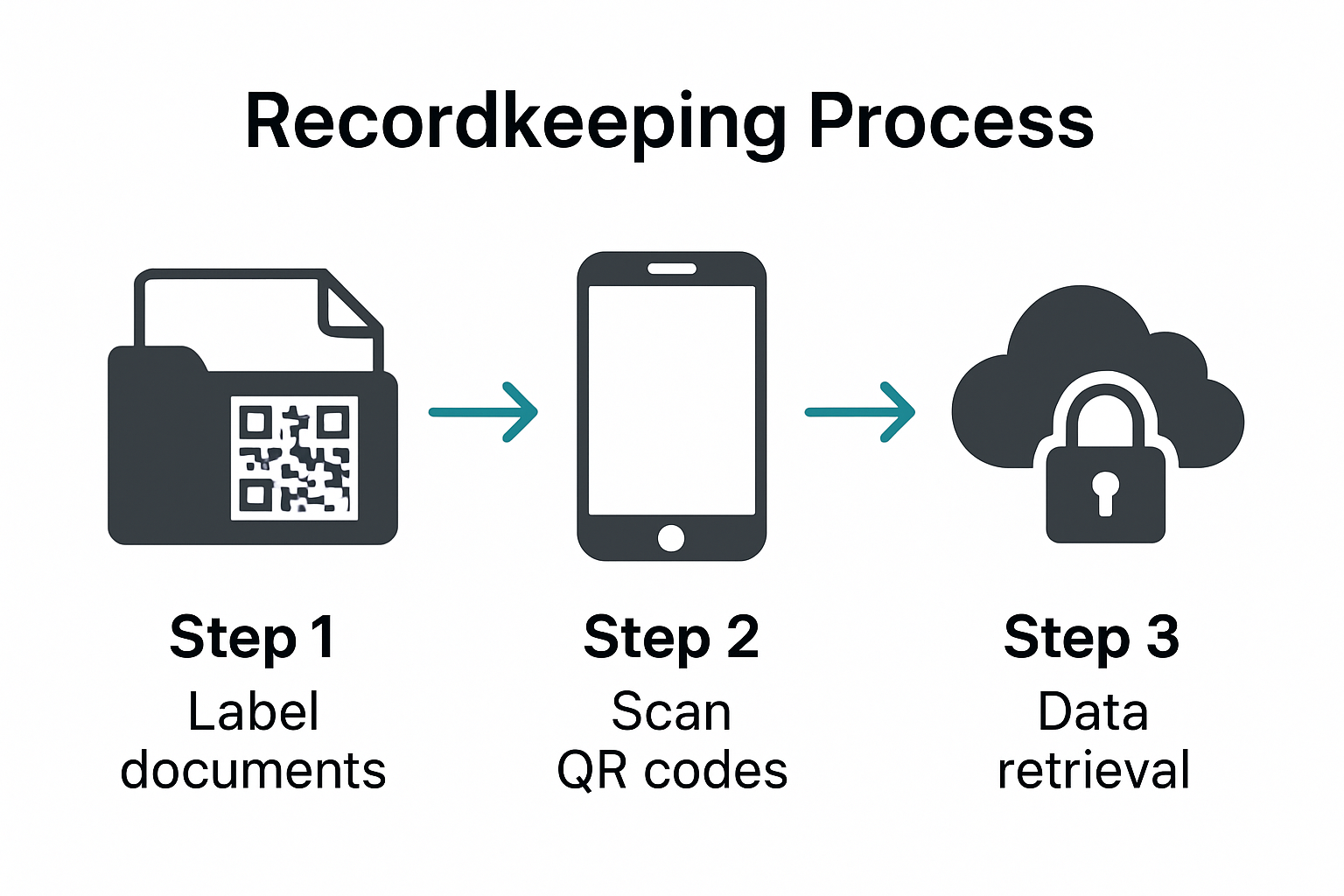
The mechanics of QR codes in recordkeeping are remarkably straightforward yet powerful. When scanned using a smartphone or specialized reader, these codes instantly retrieve stored information, creating seamless connections between physical objects and digital data repositories. This capability makes them invaluable for tracking inventory, managing personal collections, preserving historical artifacts, and maintaining organized record systems across various domains.
Key characteristics that make QR codes exceptional for recordkeeping include their high data capacity, error correction capabilities, and compatibility with multiple digital platforms. They can store up to 4,296 alphanumeric characters in a single code, making them far more versatile than traditional barcode technologies. Organizations and individuals can leverage these codes to create dynamic, easily accessible records that bridge physical and digital information landscapes.
Types of Records Managed With QR Codes
QR codes have revolutionized record management across numerous professional and personal domains, offering versatile solutions for organizing and accessing critical information. Across various sectors, these digital tools enable comprehensive record tracking with unprecedented efficiency and precision. From healthcare to education, QR codes provide seamless methods for storing, retrieving, and verifying important documents and data.
Technologies have documented extensive applications in multiple professional environments, revealing their remarkable versatility. In healthcare, QR codes manage patient records, track medical equipment, and streamline administrative processes. Manufacturing sectors utilize these codes for equipment maintenance logs, tracking production stages, and managing inventory. Government agencies employ QR codes for legal notices, public bulletins, and administrative documentation.
Academic and educational institutions have also embraced QR code technology for record management. Academic libraries leverage these tools to provide instant access to catalog information, instructional materials, and event details, transforming how students and researchers interact with institutional resources. Event management teams use QR codes for tracking attendee information, managing schedules, and sharing speaker biographical details.
The adaptability of QR codes extends to personal and business record management. Professionals can track warranties, preserve family histories, manage personal collections, and create dynamic inventory systems. Businesses benefit from their ability to encode complex information in a compact format, enabling quick verification, reducing paperwork, and creating digital bridges between physical objects and comprehensive digital records. From tracking shipping manifests to preserving archival documents, QR codes offer a flexible, efficient solution for modern recordkeeping challenges.

How QR Codes Transform Record Storage
QR codes represent a groundbreaking technological solution that fundamentally reimagines traditional record storage methodologies. Modern storage solutions leverage these digital markers to create dynamic, accessible, and incredibly efficient information management systems that transcend conventional physical filing approaches.
Educational institutions demonstrate remarkable improvements in resource management through QR code implementation, showcasing how these digital tools streamline tracking and reduce administrative errors. By enabling instant digital access to physical resources, QR codes eliminate complex manual tracking processes. Schools and universities can now monitor textbook inventories, track equipment locations, and maintain comprehensive digital records with unprecedented accuracy and speed.
Attendance tracking and personnel management have also been revolutionized through QR code technologies. Identification systems using QR codes have significantly enhanced monitoring processes, providing instantaneous and verifiable record updates. Organizations can now capture precise attendance data, manage personnel movements, and maintain comprehensive digital archives with minimal human intervention.
The transformative power of QR codes extends far beyond institutional settings. Businesses, archives, museums, and personal collections can now create intelligent, interconnected record storage systems. These digital markers allow instantaneous information retrieval, seamless data updates, and create permanent digital trails that preserve context, provenance, and historical details. From tracking warranty information to documenting family heirlooms, QR codes offer a versatile, scalable solution that bridges physical objects with comprehensive digital documentation.
Security, Privacy, and Compliance Considerations
QR code technologies present a complex landscape of security challenges and innovative solutions that demand careful consideration. Advanced security strategies are crucial for protecting sensitive information embedded within these digital markers, ensuring data remains confidential and protected from unauthorized access.
Researchers have developed sophisticated algorithms to conceal confidential information within QR code modules, creating advanced encryption techniques that allow only authorized users with specific secret keys to extract hidden data. These innovative approaches transform QR codes from simple information carriers into sophisticated secure communication tools, providing multiple layers of protection for sensitive organizational and personal records.
Cybersecurity risks are a significant concern in QR code deployment. Users must exercise caution when scanning codes from unknown sources, as malicious actors can potentially mask harmful links within seemingly innocuous digital markers. Organizations and individuals should implement robust verification protocols, including validating code sources, using secure scanning applications, and maintaining updated security software.
Compliance with data protection regulations requires a multifaceted approach to QR code implementation. Best practices include implementing encryption protocols, restricting access to sensitive information, maintaining detailed audit trails, and developing comprehensive user authentication mechanisms. By integrating advanced security technologies and maintaining vigilant monitoring systems, organizations can leverage QR codes as powerful tools for record management while mitigating potential privacy and security risks.
Best Practices for Using QR Codes Effectively
QR codes offer remarkable potential for information management, but their effectiveness depends on strategic implementation. Modern information access strategies require careful planning to maximize their utility and user engagement across various contexts.
Organizations should prioritize creating concise URLs and tracking usage metrics when deploying QR codes, ensuring optimal performance and measurable outcomes. Short, clear URLs improve scanning reliability and user experience, while comprehensive usage tracking allows organizations to assess the effectiveness of their QR code campaigns and make data driven refinements.
Accessibility considerations are paramount in QR code design and deployment. Comprehensive accessibility protocols demand thoughtful implementation, including providing descriptive alternative text, maintaining robust color contrast, and ensuring compatibility with assistive technologies. These practices guarantee that QR codes remain usable for individuals with diverse technological capabilities and potential visual limitations.
Successful QR code implementation requires a holistic approach that balances technical precision with user experience. Best practices include regular code testing, maintaining high resolution and clear printing, strategic placement in user accessible locations, and ongoing monitoring of link integrity. By adopting a comprehensive strategy that considers technical performance, user accessibility, and meaningful content delivery, organizations can transform QR codes from simple digital markers into powerful communication and information management tools.
Unlock Seamless Recordkeeping with Smart QR Code Labels
The article highlights how QR codes revolutionize record management by offering dynamic, secure, and highly accessible storage solutions. If you’re facing challenges like inefficient manual tracking or insecure document handling, Smack Tags provides the perfect answer. Our Creative – Smack Tags collection delivers durable, water-resistant QR code labels that preserve stories, simplify information access, and bridge physical items to detailed digital records effortlessly.

Start transforming your personal and business recordkeeping today. Enjoy easy linking to videos, images, and text with no app required. With 20 tags and a low yearly subscription, you can ensure reliable, long-term data storage. Visit Smack Tags and empower your recordkeeping with smart labels that protect and organize your most important items now.
Frequently Asked Questions
What are QR codes and how do they function in recordkeeping?
QR codes are two-dimensional barcodes that efficiently store substantial data in a compact format, allowing for easy access and verification of important information when scanned using a smartphone or specialized reader.
What types of records can be managed with QR codes?
QR codes can manage various records across multiple domains, including healthcare records, inventory management in manufacturing, academic resources in educational institutions, and personal collections, among others.
How do QR codes transform traditional record storage?
QR codes revolutionize record storage by creating dynamic and efficient management systems that eliminate manual tracking processes. They enable instant access to information, streamline attendance tracking, and facilitate comprehensive digital archives.
What security measures should be considered when using QR codes?
To enhance security, organizations should implement encryption protocols, restrict access to sensitive data, validate the sources of QR codes, and integrate robust verification measures for scanning. This helps protect against unauthorized access and potential cybersecurity risks.